I still don't understand why in France it is mandatory to have a fire alarm at home (if not installed) have, the home insurance is not valid) and in Spain, it is not This security measure is mandatory. Is about save lives, and an automatic fire detector for the home , bluntly, it's cheap.
Watch out! On average, almost seven out of ten deaths are produced by smoke inhalation and at night, directly or whole. And one of the things that these devices do well against an accident inside the house, is to
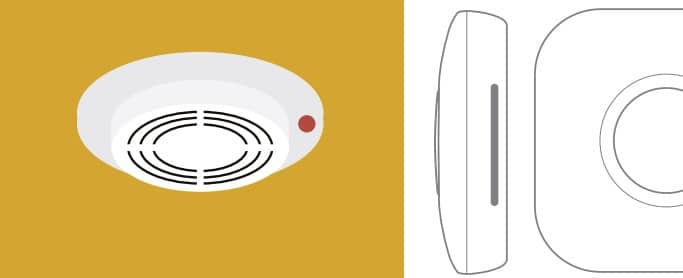
The early detection of a fire in house , is a very serious matter. Must see many aspects And buy the right device! In the following guide we explain it in detail…
Content menu:
Within emergency systems , there are two methods to detect a fire (Phase initial presence of smoke or heat – flame): a system automatic fire protection and a second, which is an activation handbook:
The installation of fire alarms can range from a smoke sensor to homes , the basic device to prevent damage materials and personnel, up to an alert system complex that even trigger barriers to protect us (Door closing, automatic extinction drive, sprinklers, alerts to firefighters, etc):
Here we could also put the security cameras to house, since some also capture the heat.
Okay! We already understand how complex they can be these emergency systems, but what type of alarm I can install fire protection at home …
The question is… What are thermal detectors? most common? Although manufacturers are always contributing new technologies, we generally find the following types of fire alarms in the shops:
You have to think that the detectors of warning fires are designed – typically – to discover one or more of the three characteristics of fire: smoke, heat and radiation (A flame).
Watch out! We are not talking about the detectors of gas for when there are anomalies in; methane, propane, butane or those that detect the abnormal presence of carbon monoxide (CO) in the air! different! Although we have manufacturers that offer us in a same element, a CO Detector + Smoke Collector.
To be more clear which models of detectors of fire exist . Better we see the following scheme where more or less, we already observed what device you will need for home, an office, a local or whatever space it is:
If we see the following image, already real devices. The models look a lot alike, but actually have different characteristics if we compare them between them; sensitivity, reliability, maintenance, price, etc.
Now comes the trick! EL compare the different models to make sure we make the right choice…
First, I would like to make it clear that, in Spain, the current regulations do not oblige to put a fire detector or smoke in the houses (Later on we will see when it is mandatory in residential, which depends on the height of evacuation).
At this key point, we already know that in the details there is the quality of the gadget and that is why we have written a guide quite wide. On these alert sensors we must look:
Though the above chart represents several points. The tolerable delay in detection is very important, that is, how quickly the device is activated. two important elements that make the mechanism of a detector against fires more reliable and effective:
Ultimately, they determine the “delay”… When will activates a fire sensor?
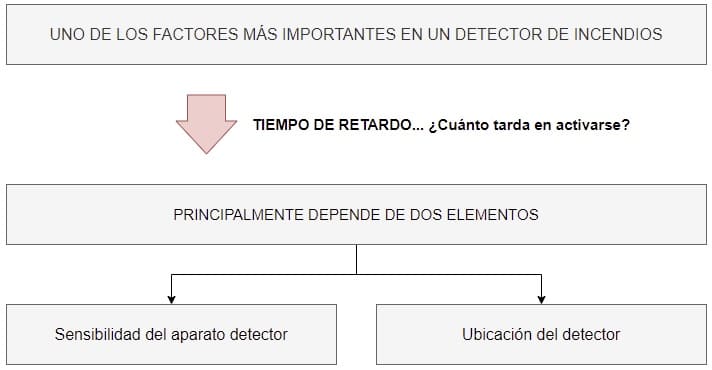
One of the main doubts when buying a smoke or fire detector is to know when the alarm is activated fire alarm . This very important factor is given by the "sensitivity of the appliance" in the event of a fire that comes jointly coupled with its location and, therefore, Of course, the type of device we buy.
In these security systems, each device is designed and made for one use. If we have a device with a very high sensitivity, on certain occasions, can give us false positives, for example, around smokers or in a kitchen by water vapor or a little smoke.
To be clearer, we first have a comparison of sensitivity in the mechanism to see how they act in the face of fire with: solid, liquid and electrical materials…
| Sensitivity compared between detectors | |||
| Type of fire | |||
| Detector type | Solid materials | Flammable liquids | Electrical |
| Gas (ionic) | Registration | Registration | Media |
| Smoke optical (photoelectric) | Registration | Lower | Media |
| Fixed temperature | Lower | Registration | Lower |
| Thermovelocimeter | Media | Registration | Lower |
| Of flames: | |||
| Ultraviolet | Lower | Registration | Registration |
| Infrared | Lower | Registration | Lower |
Secondly, we compare the teams anti-fire in relation to its characteristics; sensitivity, reliability, maintenance and stability.
| Type of detector according to features | Sensitivity | Reliability | Maintenance | Stability |
| Gas (ionic) | Registration | Media | Medium | Media |
| Smoke optical (photoelectric) | Media | Media | Medium | Media |
| Fixed temperature | Lower | Registration | Low | Registration |
| Thermovelocimetric | Media | Media | Low | Registration |
| Of flames: | ||||
| Ultraviolet | Registration | Media | Medium | Media |
| Infrared | Media | Media | Medium | Lower |
If we analyze the data a bit, in a house it was it is better to use a photoelectric smoke detector with alarm (Optical device) or ionic . remember! that also sell autonomous smoke detectors that combine technology photoelectric and ionization. For home we would have:
| Living rooms | Dining room | Bedrooms | Corridors – Hallways | Basement us | Building floors | Kitchen | Garage | |
| It is best to install a point smoke detector in the areas of | YES | YES | YES | YES | YES | YES | NO | NO |
| It is best to install a heat detector in the areas of | NO | NO | NO | NO | NO | NO | YES | YES |
But... What other aspects should you look at in these teams?
But… How much does a smoke detector cost to home? A sensor to alert us to a fire or smoke in a home costs between 20 and 50 Euros , a quality device. With Wi-Fi and other technologies, they go from 80 Euros with more complex mechanisms such as the Google Nest , for example.
Those that are wireless and punctual, more intended for home, they are cheaper. Those that are connected to the electrical network or linear in optics are already used more by professionals and increase in price.
Before you buy, always compare prices. Look at the prices in large stores such as Corte Ingles , Ikea, Leroy Merlin , Media Markt . We can also compare prices listings on Amazon or search for brands to verify the sale price.
Try to buy brands from well-known manufacturers in the market by professionals, for example; Notifier , Apollo , Bosch , System Sensor , Siemens-Cerberus , J.M. Systems, ESSER, Fire-Lite there are many!
Now you are wondering… How many sensors do I need for home? Where do I need them? put?
Obviously, it is not the same to know the number and locations to put them in a flat, dwelling or house (The regulations do not allow us to obliges), that, in a building, warehouse, local large dimensions, etc. (See the following section on the obligations according to uses). But professionals should consider:
Let's simplify!…. How many smoke detectors do I need for a flat, house or house? Although the standard does not oblige us to put one is home, yes we mean her to understand what number we need:
| Maximum monitored area | Maximum installation height up to ceiling | |
| Heat alarm sensor | 20 m2 | 9 meters |
| Smoke alarm sensor | 60 m2 | 12 meters |
As in a normal home, the height to the ceiling does not usually exceeds 3 meters, we already know that the alarm covers 60 square meters ( Covers 8 to 9 meters linear ).
Be careful around corners and under cover, you have to respect the measures.
In this aspect you have to be consistent. If we only want one, better in the corridor without closing the door (at least the access to the dining room) and without obstacles. If we have several plants, we will need more….

For adequate fire prevention we should consider:
You shouldn't put up smoke sensors at:
From a professional perspective, to expand information. A manual covering many features and different tables useful is Asepeyo's guide for the design, use and maintenance of automatic detection systems fires recommended!
One aspect should be highlighted, a detection system Automatic fire control for a home is simple and easy to install by us, but, in buildings, premises of large size, offices, warehouses, etc. It will be necessary through of professionals. Here the regulations are complex in locations and number of elements (See the following section on the obligations according to uses).
Here we stop nonsense and directly a good video to install a smoke alarm in your home Mapfre Foundation:
For a house, they are sold self-adhesive and with two screws, in case it doesn't stick well. He has no secret installation, just remember to test it to see if it works.
This alarm system has maintenance minimal , but remember to test if it works from time to time when. It should be cleaned at least once a month:
In Spain, for a home, apartment or house it is not mandatory (Yes in many countries of the European Union). but in residential for homes, which is the majority of cases, the Technical Code of Building (CTE) and Royal Decree 513/2017 (Regulation of fire protection installations) adds the obligatory when:
Broadly speaking, in the following table we can identify when is a system against fires :
| Intended use of building or establishment | Conditions |
| Residential use housing Fire detection and alarm system. | If the evacuation height exceeds 50 m. |
| Administrative use System of alarm Fire detection system. | If the constructed area exceeds 1,000 m2 If the constructed area exceeds 2,000 m2, detectors in high risk areas according to chapter 2 of section 1 of the Basic Safety Document in Case of fire. If it exceeds 5,000 m2, throughout the building. |
| Use residential-public Fire detection and alarm system. | If the constructed area exceeds 500 m2 |
| Hospital use Fire detection and alarm system. | Anyway. The system will have connected sensors and manual pushbuttons and must allow the transmission of local alarms, alarm general and verbal instructions. If the building has more than 100 beds. must count with direct telephone communication with the firefighters. |
| Instructional use Alert system. Smoke presence system. | If the constructed area exceeds 1,000 m2 If the constructed area exceeds 2,000 m2, appliances in high risk areas according to chapter 2 of the Section 1 of the Basic Security Document in Case of Fire. If it exceeds 5,000 m2, throughout the building. |
| Commercial use Alarm system. Fire detection system. | If the constructed area exceeds 1,000 m2 If the constructed area exceeds 2,000 m2 |
| Use public concurrency Alarm system. Smoke detection system. | If occupancy exceeds 500 people, The system must be capable of issuing messages by public address system. If the constructed area exceeds 1,000 m2 |
| Parking use Smoke detection system. | In conventional car parks whose constructed area exceeds 500 m2 Parking lots robotic systems will have alarm buttons throughout case. |
Remember that the Fire Regulations are broad and constantly changes as shown by the Spanish Society of Fire Protection Tecnifuego, so the box above is indicative. Not to mention that in many cases it is necessary a security study + project corresponding.
By the way, since we are talking about possible damage to the home. We have an extensive article on how to detect damage in houses and structures after earthquake - earthquake.
If you liked the article, rate it and share!
